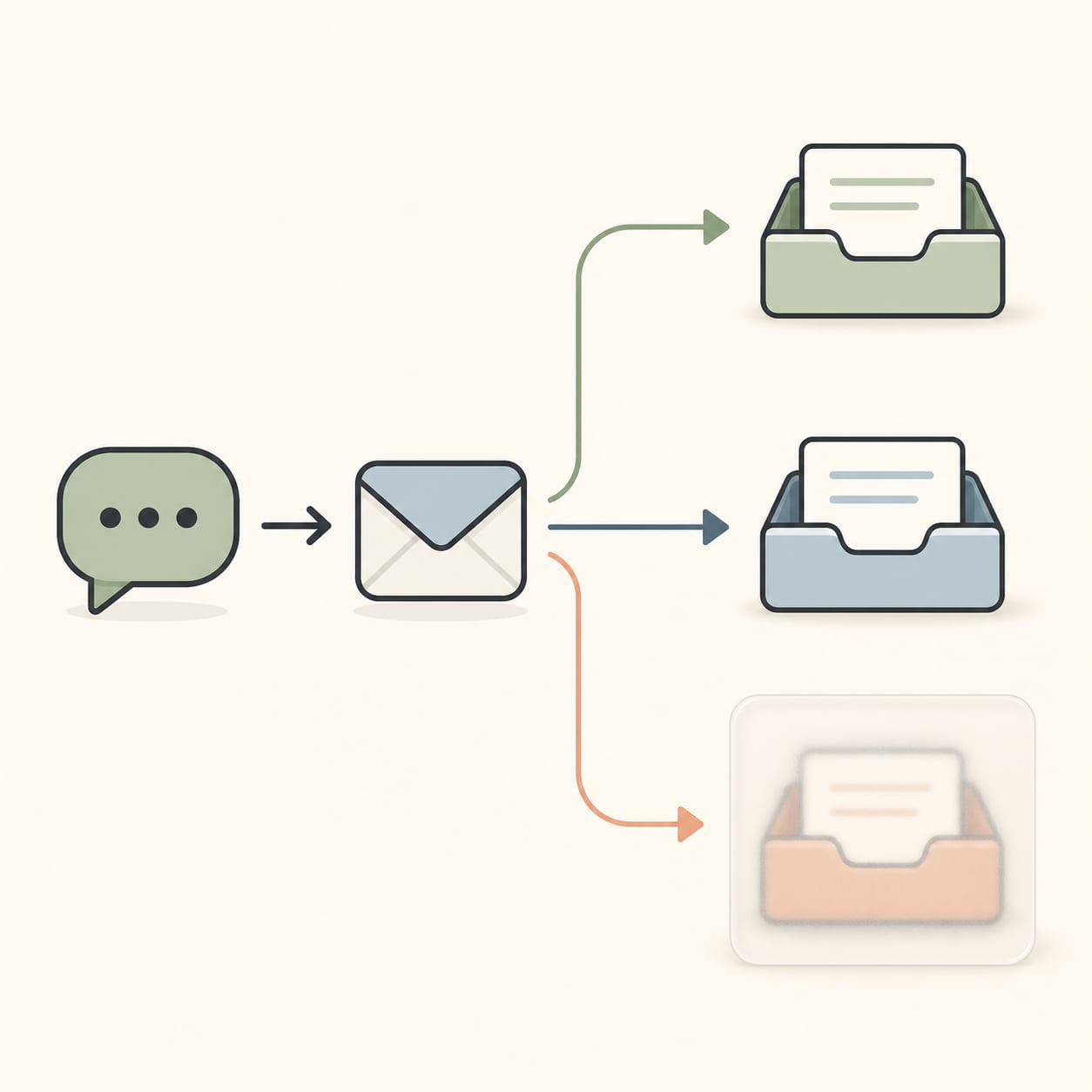
If your comment-to-DM dashboard says a message was sent but the commenter cannot see it in their main inbox, the automation may be working correctly. Meta's own Private Replies documentation says the first message goes to the person's Inbox when they follow the professional account, but to Requests when they do not. Instagram may place some requests in Hidden Requests without notifying the recipient.
The useful question is not simply "did the DM work?" It is whether the comment triggered, whether Meta accepted the private reply, and where Instagram placed it. Those are three separate checkpoints.
First separate delivery from inbox placement
A missing DM can describe very different failures:
| What you observe | Likely stage | What to check next |
|---|---|---|
| No campaign event for the comment | Trigger never arrived or keyword did not match | Media selection, campaign status, keyword rule |
| Comment registered, but the send failed | Delivery was attempted and rejected | Account connection, permissions, API error |
| Sent count increased, but nothing is in Primary | Meta accepted the message | Requests, then Hidden Requests |
| Message appears in Requests | Normal non-follower placement | Tell the commenter where to look |
| Message appears in Hidden Requests | Instagram filtered the request | Recipient must review or accept it |
This distinction prevents the most common troubleshooting mistake: reconnecting the Instagram account repeatedly when the API send already succeeded.
If comments are registering but no DM is being sent at all, start with the broader comment-to-DM troubleshooting checklist. If sends are succeeding and people cannot find them, stay with the placement test below.
Run a clean second-account test
Do not test from the creator account or from an account with an old conversation. Existing relationships can change where Instagram places a message.
Use this sequence:
- Choose a second Instagram account that does not follow the creator and has no existing DM thread with it.
- Confirm the campaign is live and attached to the correct post or Reel.
- Leave a new comment that clearly matches the configured keyword.
- Check whether the campaign's participant or sent-DM count changes.
- On the second account, open DMs, then Requests, then Hidden Requests.
- If the message is found, accept the request and reply once. That establishes a conversation for any permitted follow-up.
Use a fresh comment for another attempt. Meta allows only one private reply per comment, so deleting and reposting the same text as a new comment is a cleaner retest than expecting the original comment to trigger twice.
For a useful comparison, repeat the test with another account that already follows the creator. Meta documents that a follower's private reply appears in the Inbox, while a non-follower's appears in Requests. If the follower receives it normally and the non-follower finds it in Requests, the automation is not leaking or losing messages. You are observing Instagram's delivery controls.
Why some requests become Hidden Requests
Instagram says potentially offensive, unwanted, or spam-like message requests can be moved into a separate Hidden Requests folder. Requests can also be hidden because of the recipient's Hidden Words preferences. Instagram does not send a notification for messages placed there.
That creates a difficult symptom for creators: the API can return a successful message ID while the recipient sees no notification and no message in Primary. A successful send proves that Meta accepted the request. It does not prove that Instagram displayed it prominently.
Avoid turning this into a universal claim that certain words always cause filtering. Meta does not publish a guaranteed list of phrases that move an automated DM into Hidden Requests. Copy may be worth testing, but no automation vendor can promise that replacing one emoji or link will force Primary-inbox placement.
What you can improve
Set expectations before the comment. A caption such as "Comment GUIDE and check your Instagram Requests if we have not chatted before" prepares a non-follower for the folder Meta documents.
Use a short public reply after the DM is submitted. "Sent. Please check Requests too" is more useful than a vague "Check your messages." Keep reply variations natural if many people comment at once, but treat this as guidance for the person, not an inbox-ranking trick.
Make the first private reply recognisable. Name the resource they requested and use one clear action. A commenter who sees "Your meal plan is ready" can identify the message faster than a generic greeting. Avoid stacking unrelated offers into the opener.
Finally, test the whole journey before publishing the Reel. Testing from a non-following account catches request-folder friction that a creator's own account cannot reproduce.
What a follow gate cannot fix
A follow gate can be valuable when the reward is worth exchanging for a follow, but it cannot guarantee placement of the first message. The commenter must first receive and open that initial private reply before they can interact with a follow prompt inside it.
This means "ask them to follow" is a campaign decision, not a technical cure for Hidden Requests. If too many people stall before seeing the reward, compare the completed unlocks with total participants using the Instagram DM funnel metrics that matter. Do not judge the funnel from public comment count alone.
What the automation provider cannot control
An official-API tool can detect the matching comment, submit one permitted private reply, record whether Meta accepted it, and pace work during a spike. It cannot:
- Select Primary instead of Requests
- Remove a message from Hidden Requests
- Change the recipient's Hidden Words preferences
- Accept the request for the recipient
- Force an Instagram notification
- Send repeated follow-ups when the recipient has not responded
Meta permits one private reply within seven days of the comment. Further messages are allowed only after the recipient responds, and they must stay within the documented 24-hour response window. Any tool promising repeated cold follow-ups is solving a different problem by crossing a platform boundary.
Sources checked
Checked August 23, 2026:
- Meta's official Instagram API Private Replies documentation
- Instagram Help Center: Hidden message requests
- Instagram Help Center: sending a message to someone
FAQ
Why does an Instagram auto-DM go to Message Requests?
Meta says a private reply goes to the recipient's Inbox if they follow the professional account and to Requests if they do not. This is expected Instagram behavior.
Can an automated Instagram DM land in Hidden Requests?
Yes. Instagram may hide requests it considers unwanted or spam-like, or that match the recipient's Hidden Words settings, without sending a notification.
Can my automation tool force a DM into Primary?
No. Inbox placement, filtering, acceptance, and notifications belong to Instagram and the recipient's account settings.
Does a public reply move the DM out of Requests?
Meta does not document that effect. Use a public reply to tell people where to look, not as a guaranteed technical fix.
Should I resend the DM from the automation?
Not against the same comment. Meta allows one private reply per comment. Diagnose the original placement, then use a new comment or second account for a controlled retest.
UnlockDM uses Meta's official Instagram API and tracks campaign sends separately from participant unlocks, helping creators distinguish a message attempt from a completed reward journey. Instagram still controls the recipient's inbox placement.